
- Interstellar comet 3I/ATLAS has yielded Webb’s first-ever chemical fingerprint of an object from beyond our Solar System.
- Webb detected methane on interstellar comet 3I/ATLAS for the first time, a find that surprised scientists with its unusually high concentration.
- The comet also carries far more carbon dioxide relative to water than typical Solar System comets, pointing to alien formation chemistry.
- Both observations suggest 3I/ATLAS formed in a very different environment — possibly around another star entirely.
- Interstellar comet 3I/ATLAS has yielded Webb’s first-ever chemical fingerprint of an object from beyond our Solar System.
- Webb detected methane on interstellar comet 3I/ATLAS for the first time, a find that surprised scientists with its unusually high concentration.
- The comet also carries far more carbon dioxide relative to water than typical Solar System comets, pointing to alien formation chemistry.
- Both observations suggest 3I/ATLAS formed in a very different environment — possibly around another star entirely.
Webb Gets Its First Chemical Read on Interstellar Comet 3I/ATLAS
The James Webb Space Telescope has done something no observatory has managed before: it’s taken a proper chemical snapshot of interstellar comet 3I/ATLAS — an object that doesn’t belong to our Solar System and is just passing through. The results, published in The Astrophysical Journal Letters, reveal a composition so distinct from anything that formed around our Sun that astronomers are still unpacking what it means.
We’ve had interstellar visitors before. ‘Oumuamua showed up in 2017 and baffled scientists with its strange elongated shape and non-gravitational acceleration. Borisov arrived in 2019 and behaved far more like a conventional comet — reassuringly familiar in many ways. Now interstellar comet 3I/ATLAS is the third confirmed interstellar object to pass through our neighbourhood, and it’s turning out to be the most chemically revealing of the lot. That’s almost entirely thanks to Webb.
Two Windows, One Outbound Comet
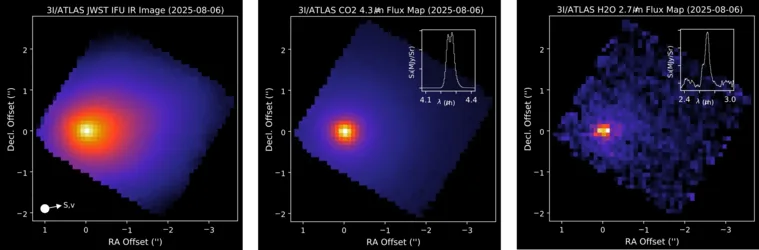
Webb caught interstellar comet 3I/ATLAS on two separate occasions as it was already heading back out of our Solar System, post-perihelion — meaning it had already made its closest approach to the Sun and was retreating. The first observation window ran from 15 to 16 December, when the comet sat roughly 330 million kilometres from the Sun. The second came on 27 December, by which point it had drifted to about 380 million kilometres out.
That setup matters for interpretation. The comet was cooling down, not heating up, which means what Webb detected during these observations reflects what the Sun’s heat had already managed to unlock from the icy body. It’s a snapshot of a departing visitor, still venting gases that had been sealed beneath its surface for — potentially — billions of years.
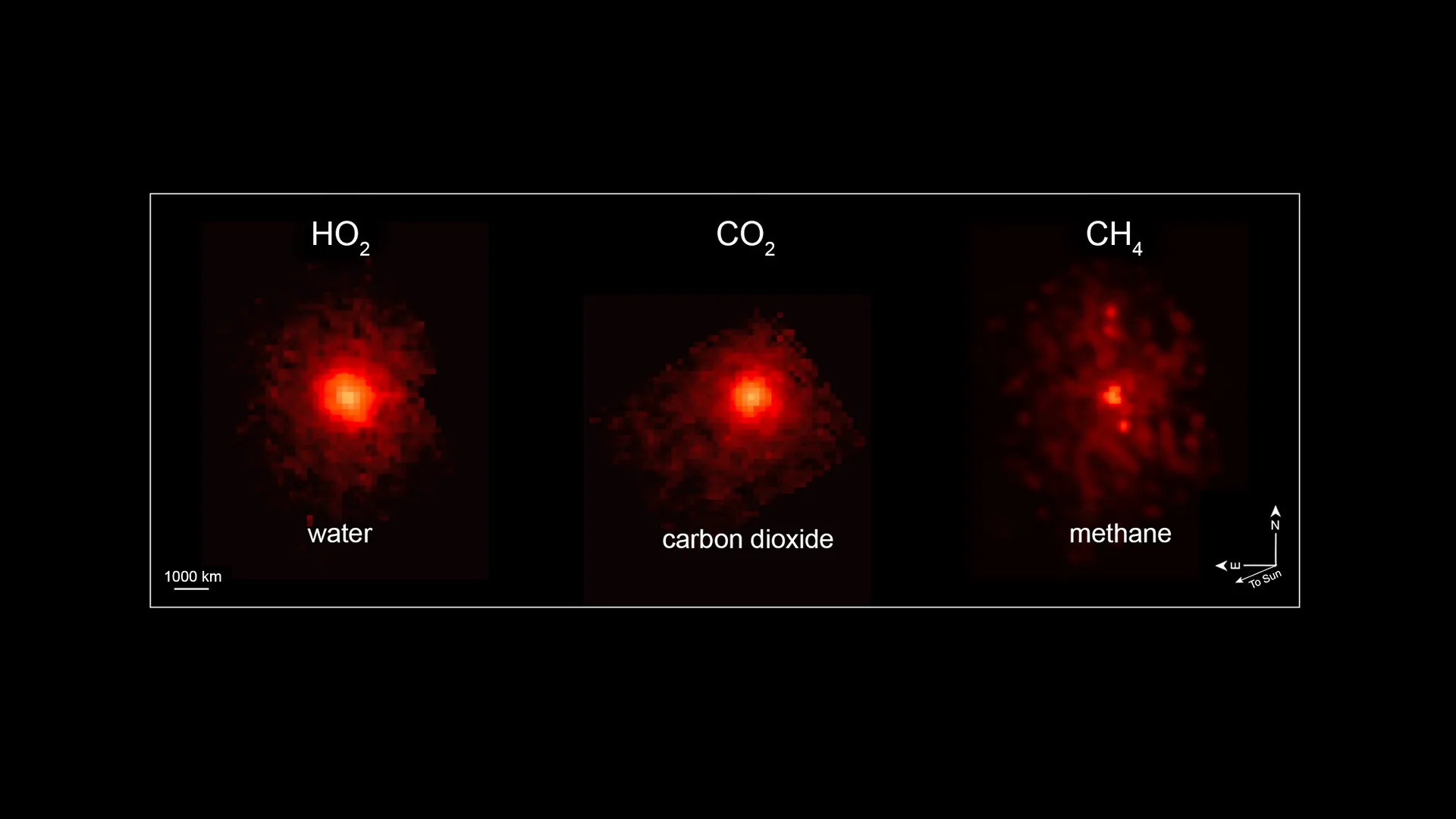
The instrument doing the heavy lifting was MIRI’s Medium Resolution Spectrometer, part of Webb’s Mid-Infrared Instrument. This isn’t a simple camera. It breaks infrared light into its component wavelengths at every point across a small patch of sky simultaneously, producing what’s essentially a chemical map rather than just a single averaged reading. The team could see not just what gases were present, but where they were distributed around the nucleus — a genuinely powerful capability that older telescopes simply couldn’t match.
Methane: The Headline Find
Of all the detections Webb made, the methane finding is the one that’s drawing the most attention. This is the first time methane has been directly detected on any interstellar visitor, and the amount relative to water is, according to the research team, surprisingly high — at a level that’s rare even among comets that formed in our own Solar System.
Why hadn’t methane showed up before on interstellar comet 3I/ATLAS? The working explanation is that it was buried. Methane is a volatile molecule — it evaporates easily at relatively low temperatures. If it had been sitting near the surface during its inbound journey toward the Sun, it would have boiled off long before Webb got a look. The fact that it was detected during the outbound phase suggests it was locked away beneath the comet’s icy outer shell, protected from the Sun’s heat until that warmth finally penetrated deep enough to release it. Think of it like an iceberg that only reveals its core chemistry after prolonged exposure.
That depth-dependent release is itself an important clue about the comet’s internal structure. It implies a layered body — one where surface volatiles have already been processed or stripped away, but where deeper material has remained pristine, possibly since the object’s formation around another star.
Carbon Dioxide That Doesn’t Add Up — By Our Standards
Methane wasn’t the only chemical surprise. Webb’s observations confirmed what earlier data had hinted at: interstellar comet 3I/ATLAS is releasing far more carbon dioxide relative to water than any typical Solar System comet. The ratio is genuinely anomalous compared to the population of comets we know well, including those from the Kuiper Belt and the Oort Cloud.
In most comets that formed around our Sun, water is the dominant volatile, with carbon dioxide and carbon monoxide present in much smaller proportions. Interstellar comet 3I/ATLAS doesn’t follow that pattern. Its carbon dioxide abundance points to formation conditions that were either much colder, or chemically different in composition, than the outer Solar System environments that produced our own comets.
Taken together — the methane levels, the carbon dioxide ratios, the overall volatile budget — the picture that emerges is of an object that condensed in a fundamentally different planetary system. The specific mix of ices locked inside interstellar comet 3I/ATLAS acts like a chemical timestamp, and what it’s telling us is that wherever this comet came from, it wasn’t here.
What This Means for Planetary Science — and the Search for Life
There’s a reason this finding generates excitement beyond just the astronomy community. The chemistry of comets is thought to be intimately tied to the chemistry of planet formation. In our own Solar System, comets are considered to have delivered significant amounts of water and organic molecules to the early Earth — potentially seeding the conditions for life. If other stellar systems produce comets with dramatically different chemical inventories, that raises genuine questions about whether those systems could follow similar pathways.
A comet carrying unusually high methane and carbon dioxide ratios tells us something about the protoplanetary disk it formed in: it was likely cold, possibly far from its host star, and rich in carbon-based ices. Whether that’s a sign of a system more or less hospitable to life than our own is a question scientists can’t yet answer — but it’s one they’re now actively asking.
It’s also worth zooming out to appreciate just how rare this opportunity is. Interstellar objects are almost certainly passing through our Solar System all the time — we just haven’t had the detection capability to spot them consistently. ESA’s coverage of the Webb observations notes that interstellar comet 3I/ATLAS is only the third confirmed interstellar object ever identified. That’s three data points across all of recorded human astronomy. The sample size is, to put it diplomatically, tiny.
Webb Is Only Getting Started
Webb’s ability to chemically characterise interstellar comet 3I/ATLAS in this level of detail — spatial distribution of gases, specific molecular detections, two observation epochs — is a demonstration of what the telescope was genuinely built for. It’s not just imaging pretty nebulae. Its infrared spectrometers are purpose-made for exactly this kind of molecular forensics, and the 3I/ATLAS result is arguably one of the most scientifically significant things it’s done since launch.
The broader implication is this: if interstellar objects do pass through regularly, and if Webb (or its eventual successors) can intercept them chemically in the way it’s just done with interstellar comet 3I/ATLAS, we’re looking at the prospect of building a genuine comparative library of exosolar chemistry — without ever leaving our own Solar System. That’s an extraordinary thing. Each interstellar visitor that gets a proper spectroscopic workup adds another data point to our understanding of how planetary systems form, what they’re made of, and how different or similar they are to our own.
3I/ATLAS is already gone, heading back into the void between stars. But the data Webb captured during those two December observation windows will keep astronomers busy for a long time. And the next interstellar visitor — whenever it arrives, whatever it brings — will now be greeted by a scientific community considerably better prepared to understand it.